What the Model Never Heard
Voice AI inherited a belief from English and Mandarin: progress is a modelling problem.
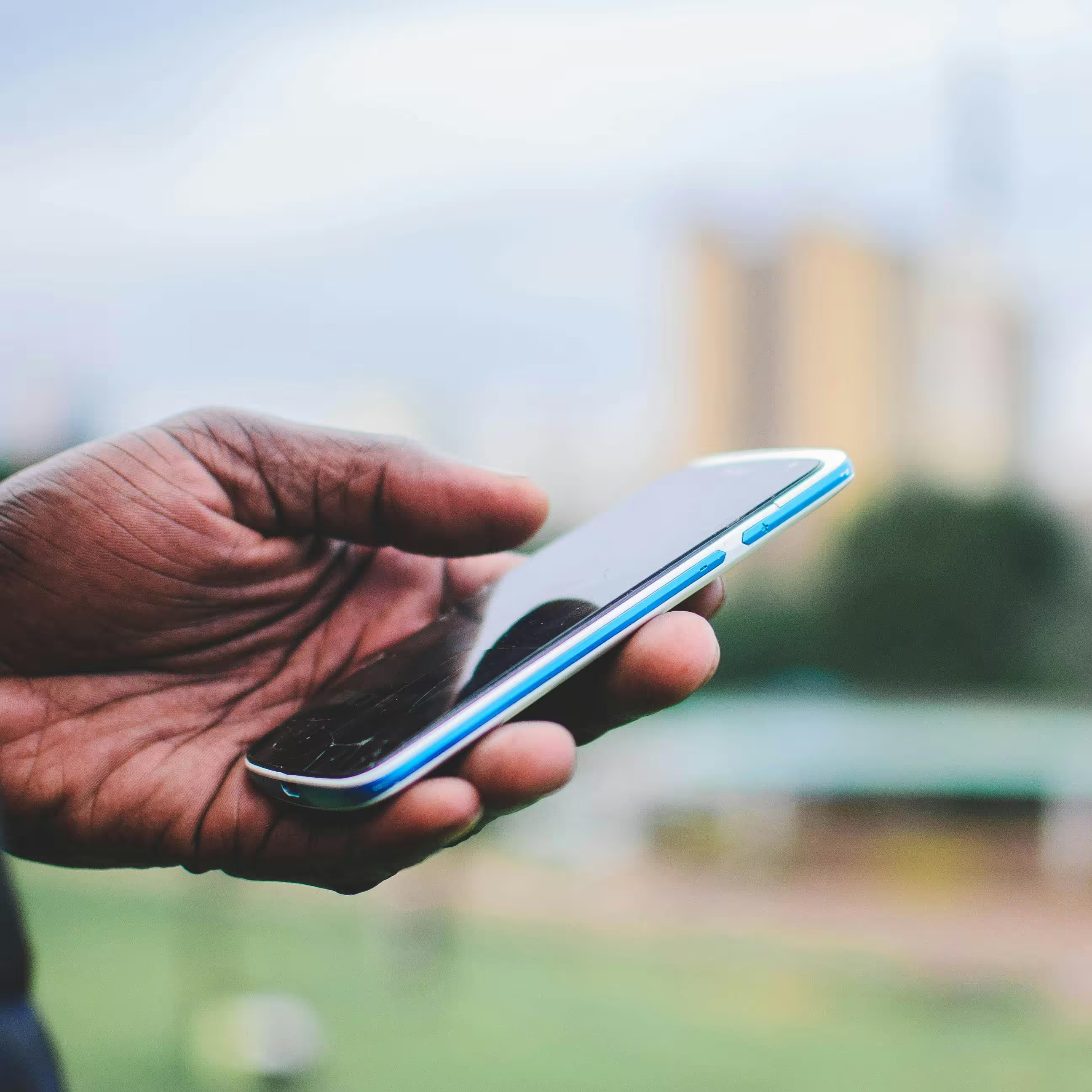
Voice AI inherited a belief from English and Mandarin: progress is a modelling problem. Make the architecture bigger, the training run longer, and the next benchmark falls. For Luganda, Hausa, isiZulu, that belief was a misread. The architectures already work. What they lacked was something more boring and harder to fund — hours of labelled, in-dialect speech. The wall sat upstream of the GPU.
The mechanism is plain. A multilingual speech-recognition model is only as good as the hours it has heard. Whisper transcribes English at near-human accuracy because it ingested colossal volumes of English audio. Point the same model at a language with near-zero public speech corpus and it collapses — word error rates climb past the point of use. The 2025 literature is candid about this. Fine-tuning Whisper for Swahili documents the ceiling that scarce data imposes 4; the Amharic work reaches the same conclusion from a different language family 5; a 2025 survey of African low-resource speech recognition names data scarcity, not model capacity, as the recurring reason ASR fails low-resource languages 7. This is the interface deficit in its most literal form: a language can be spoken fluently by millions and still go unheard by the machine, because no one paid to record it. Add tone, code-switching, and accents that cross borders, and the data problem compounds.
That is the part 2025 started to fix — quietly, through corpora rather than products.
The largest is WAXAL. Google Research, working since 2021 with African universities and community organisations — Makerere, the University of Ghana, Digital Umuganda, AIMS Senegal among them — released an open speech dataset spanning more than 11,000 hours of audio from nearly two million recordings. Within that, roughly 1,250 hours are transcribed for ASR, and over 20 hours are studio-grade recordings for text-to-speech 3. Google's framing puts the language count at 21 in the launch announcement 310 and at 27 in the research write-up 12 as coverage expands — either way, a permissive license and community-built provenance. The languages are named, not gestured at: Hausa, Luganda, Yoruba, Acholi, Igbo, Swahili, Fula 10.
It is not alone. African Next Voices — branded Swivuriso — targets 3,000 hours across seven South African languages, deliberately mixing scripted and unscripted speech to capture how people actually talk, collected through community-centred consent processes 1112. The Gates Foundation calls it the largest voice dataset of its kind 17. Separately, the African Voices corpus holds more than 3,000 hours of transcribed audio across five Nigerian and Malian languages — Bambara, Hausa, Igbo, Nigerian Pidgin, and Yorùbá 8. Three releases, overlapping languages, all open. A year ago this material did not exist in public.
"Open" is the load-bearing word, because it changes who gets to build. A corpus behind a corporate wall produces one company's product. A permissively licensed corpus produces a floor anyone can stand on. The 500-farmer Shona livestock-pricing voice agent — the deployment that never clears a platform's revenue bar — now has speech data it could never have funded alone. The economics line up. Inference cost fell more than 90% in eighteen months, from roughly $0.50 to $0.03 per query (TAUR's tracked figures). The model is cheap. The remaining gate was hearing the user. For low-literacy, last-mile users — the population smartphone-first tooling skips — voice is not a nice-to-have; it is the interface. Lelapa AI's Vulavula already sells code-switching-aware speech-to-text into African contact centres 15, and its InkubaLM shows compact, resource-efficient models work once the data exists 618. Data, not model size, was the constraint.
Now the honest part. These corpora are uneven. Coverage skews toward the languages with the most speakers and the most institutional backing; rural dialects, women's speech, and domain-specific vocabulary remain under-sampled — a known gap the Swivuriso team's scripted-plus-unscripted design is built to narrow 12. "Permissive" is not "unconditional"; license fine print still constrains some commercial use, and a builder should read it before shipping. Twenty-odd hours of studio TTS 3 is a seed, not a forest. And a dataset is not a deployed system — fine-tuning still demands engineering, as every 2025 Whisper paper attests 45.
The reframe holds. For years the story was that African-language voice AI waited on better models. It waited on someone to do the unglamorous work of recording people speaking. In 2025, consortia, in-country labs, and community organisations did exactly that — and put it in the open. The frontier was never the model. It was the corpus, and the distribution that sits on top of it. The people quietly assembling the hours are doing the load-bearing work.
Ready to build at the edge of where AI ends and people begin?
Get Early Access